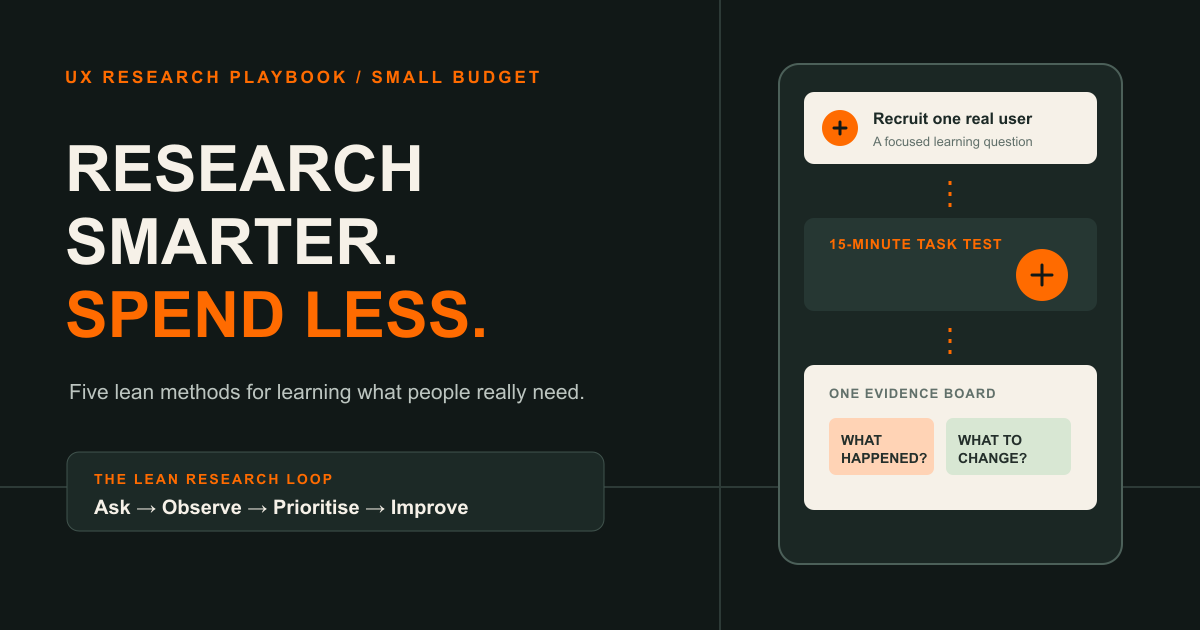


Good user research is not a luxury reserved for teams with a dedicated lab and a large budget. It is a habit of reducing uncertainty before expensive decisions are made.
With a focused question, a small group of the right people, and a lightweight way to capture what you learn, even a lean team can uncover the friction that matters most. This guide shows how to do it without mistaking activity for insight.
Start With One Decision, Not a Broad Brief
A limited budget becomes a strength when it forces focus. Instead of asking whether people “like” a product, write down the one decision your team needs to make: Should we change onboarding? Why do qualified leads abandon the form? Can customers understand the new pricing?
A useful research question is specific enough to guide what you watch for, but open enough to let unexpected patterns appear. It keeps you from paying for answers you will not use.
- Weak question: “What do users think of the website?”
- Useful question: “What information do first-time visitors need before they feel confident requesting a quote?”
- Useful question: “Where does a new customer lose momentum while setting up their first project?”
Use the Evidence You Already Have
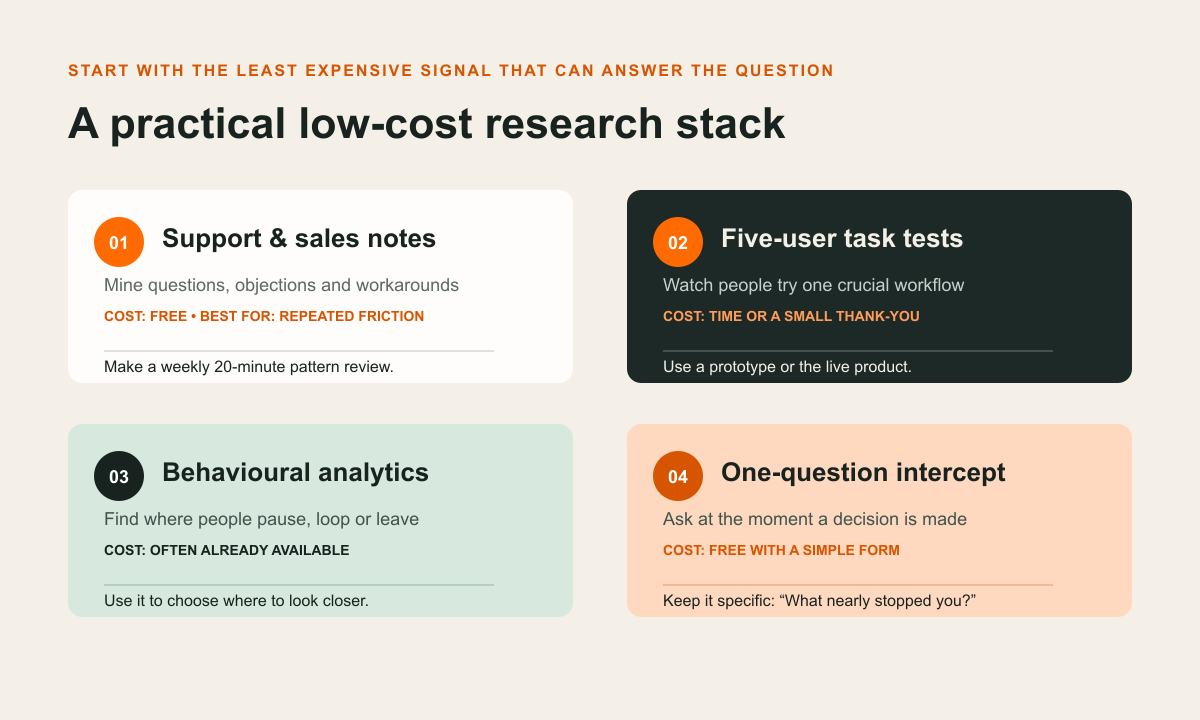
Before recruiting anyone, look at the conversations and behaviour your business already creates. Support tickets, sales-call notes, form responses, search terms, app reviews and session analytics are all low-cost signals. They are not a substitute for watching people use a product, but they are excellent at showing where to look.
Create a simple evidence board with three columns: what happened, what it might mean, and what we need to validate. Separate direct quotes or observed behaviour from your interpretation. That single discipline prevents a team from treating a hunch as a finding.
Choose the Right Method for the Risk
Every research method answers a different kind of question. Interviews help you understand context, motivation and language. Usability tests show where an interface breaks down. Surveys are useful when you need to measure the size of a known pattern. Analytics show where to investigate, but rarely explain why the behaviour happened.
- Use interviews when you need to understand the problem before designing a solution.
- Use task tests when you need to learn whether people can use a page, flow or prototype.
- Use a short survey when you have a focused question and enough relevant respondents.
- Use analytics to identify high-friction moments worth studying with people.
Create a Lightweight Discussion Guide
A discussion guide keeps a short session consistent without turning it into a script. It should be a page of prompts, not a questionnaire. Start with the participant's situation, move into the relevant task, and leave room to follow the details that matter.
- Warm-up: Ask about their current process, needs and constraints.
- Context: Find out what triggered the task and what a successful outcome looks like.
- Task: Give a realistic scenario and observe the path they choose.
- Reflection: Ask what felt clear, uncertain, useful or missing.
- Close: Invite anything you did not ask about that would improve the experience.
Ask Questions That Reveal Behaviour
People are often generous, polite and poor at predicting their future behaviour. Questions about a real recent experience are more reliable than hypothetical opinions. Replace “Would you use this?” with “Tell me about the last time you tried to do this.”
- Ask for examples, not approval: “What happened next?”
- Probe the moment of friction: “What were you expecting here?”
- Use neutral language so you do not lead someone toward the answer you want.
- Do not explain the interface during a task; confusion is useful evidence.
Recruit Five Relevant People, Not Fifty Random Ones
For early usability work, a handful of people who resemble your real audience is often far more valuable than a large generic survey. Start with recent customers, qualified leads, newsletter subscribers, community members or people referred by your network. Be transparent about the time required and offer a small thank-you if you can.
- Recruit against a behaviour or need, not just an age or job title.
- Use a short screener: what have they tried, what is their goal, and how recently did they face this problem?
- Do not recruit friends or colleagues for a decision that depends on genuine customer behaviour.
- Five sessions can reveal recurring usability friction; do more when you need confidence across distinct audience segments.
Run Short, Task-Based Sessions
You do not need a formal lab. A video call, a prototype, and permission to record notes are enough. Give the participant a realistic goal instead of a list of instructions: “You need to compare two options and decide which fits your team,” not “click the pricing tab.”
Ask them to think aloud. Then stay quiet. Your job is to notice hesitation, workarounds, missing information and the words people use—not to persuade them that the design makes sense.
- Set context and explain that you are testing the product, not the participant.
- Give one task at a time and let them choose their own path.
- Probe after the task: “What did you expect to happen?” and “What made that feel unclear?”
- Capture short quotes, observable behaviour and exact points of friction.
Turn Notes Into Priorities, Not a Long Report
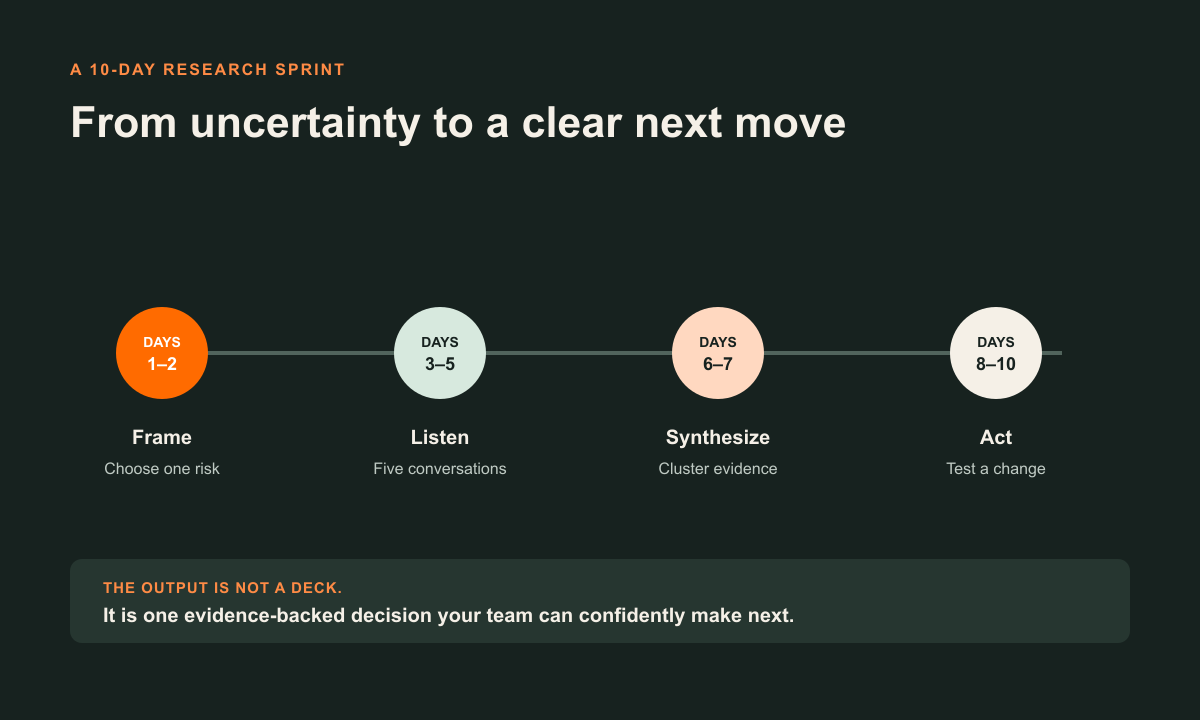
After every session, capture the same four things: the task, what the person did, what they said, and the impact on their goal. Then group similar observations. A pattern is stronger when it appears across people, tasks and data sources.
Prioritize findings by the harm they cause, not by how dramatic they sound. Focus first on problems that block an important task, create avoidable uncertainty, reduce trust, or push people into support.
- High priority: people cannot complete a core task or misunderstand a critical commitment.
- Medium priority: people complete the task but with doubt, delay or unnecessary work.
- Low priority: polish issues that do not materially change the outcome.
Share Findings So the Team Can Act
A research readout does not need to be long to be persuasive. Share the decision you were investigating, the people you spoke with, the strongest evidence, and the next action. Pair each key finding with a direct quote, observation or behavioural signal so stakeholders can see the basis for the recommendation.
A one-page summary is usually enough: three to five findings, their impact, confidence level, and the owner of the next experiment. This keeps insight close to the work instead of leaving it in a forgotten slide deck.
Common Low-Budget Research Mistakes to Avoid
- Trying to answer everything: a broad study creates vague insights. Focus on one decision at a time.
- Only asking internal teams: colleagues have useful context, but they are not a replacement for customers.
- Treating one comment as a trend: look for repeated behaviour and confirm important patterns with more than one source.
- Collecting notes without a decision: every study should end with a next action, owner and deadline.
- Skipping consent: tell participants why you are speaking with them, how notes or recordings will be used, and that they may stop at any time.
A Simple Budget Plan You Can Repeat
Make research a recurring operating rhythm rather than a one-time project. Choose one product risk each month. Spend a few days reviewing existing evidence, speak to five relevant people, share a one-page summary, and test the most promising improvement.
The best low-budget programme is not the one with the most methods. It is the one that repeatedly connects what customers experience to what the team builds next.
Final Thoughts
A small research budget should change the scope of your question, not your commitment to learning. Start with a decision that matters, make space for direct observation, and let evidence—not internal opinion—shape the next move.
When teams learn in small, regular loops, they catch expensive mistakes earlier and build with far more confidence.
Want help turning customer evidence into a clearer website or product experience? Talk to Webx Design Studio about your project.